Silver Seed Farms
Solar Energy in Missouri
|
Solar Energy Services offered:
~Photovoltaics and Solar Thermal~ *consultation *energy analysis *design *installation BPI certified Energy Analyst and Building Envelope Professional: *energy audit *weatherization silverseedfarmsrex@gmail.com 314-995-9247 |
Did you Know?
Ameren UE and Kansas City Power & Light offer a $2 per watt rebate for solar power installed, which results in significant savings! * * * * * * * ALSO: Take advantage of Missouri Solar Rebates and Incentives! Solar equipment, with an energy audit, is covered (n/a with rebates). cleanenergyauthority.com Learn about the 30% Federal tax credit through the Residential Energy Efficient Property Credit and use Tax Form 5695. |
Consultation - I will meet with you to discuss your goals, establish your energy needs, and assess your solar and site potential.
Energy Analysis - I will evaluate your existing equipment and appliances, as well as your previous year's electrical usage, to determine what gains can be made through efficiency and conservation.
Design - I will develop an individualized, integrated system plan that balances your needs of energy production and affordability. We have maximum flexibility in systems design, since we are not affiliated with any particular equipment company, allowing us to provide the equipment that will work best for you, in your situation.
Installation Team- I will supervise your project by coordinating the order, delivery and installation, and install your system along with licensed electrician, and/or plumbing and HVAC professionals.
Energy Analysis - I will evaluate your existing equipment and appliances, as well as your previous year's electrical usage, to determine what gains can be made through efficiency and conservation.
Design - I will develop an individualized, integrated system plan that balances your needs of energy production and affordability. We have maximum flexibility in systems design, since we are not affiliated with any particular equipment company, allowing us to provide the equipment that will work best for you, in your situation.
Installation Team- I will supervise your project by coordinating the order, delivery and installation, and install your system along with licensed electrician, and/or plumbing and HVAC professionals.
We have lived off-grid and mainly powered by solar energy in Missouri for over a decade (since 1998). We started out with a very small system and have added to it over time. Our system is still small by some standards. We are fairly frugal with our energy usage and have absolutely no phantom load. It has been an enjoyable and satisfying experience to be using the amazing power of the sun.
Solar electric power is clean, reliable, affordable, safe, long-lasting and requires very little maintenance. Photovoltaic solar panels create energy wherever the sun shines, be it on Earth or in space. In developing nations, solar panels have by-passed the electric grid, just as the cell phone has by-passed the land line. Remote homeowners have relied on PVs for decades. Now, with grid intertie systems, solar power is readily available for everyone. In addition, modern solar thermal power offers opportunity for solar hot water and solar home heating.
These systems can be installed for ground mounting or
mounted on a rooftop - sky's the limit!
Photovoltaic Systems
Photovoltaic Solar Power
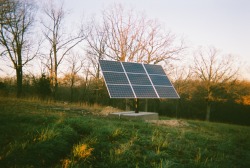
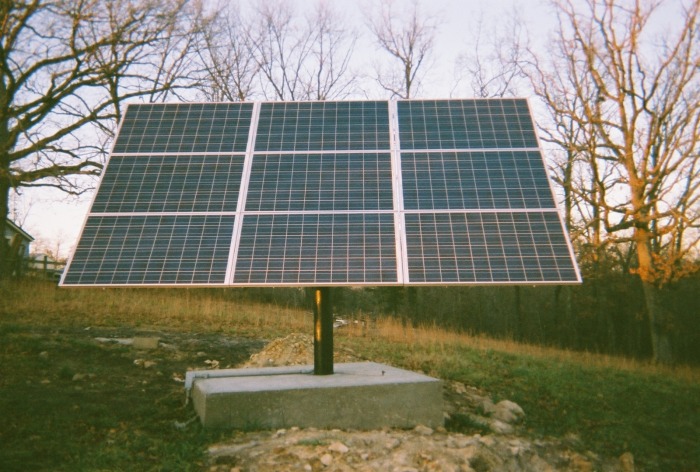
9 REC 215 watt PV panels
Photovoltaics provide the electrical energy that we can use to power our appliances and our dreams. With manufacturer warranties of up to 25 years, PVs are a long-term, reliable investment that will buffer you from a volatile energy market. Since most people in America are already connected to the electric grid, photovoltaic grid intertie makes a lot of sense. Net metering (Prop. C in Missouri) allows for you to produce energy at your own home and then use that energy, measured in kW hrs, to offset, at the consumer price rate, what you consume from your electric supplier.
In remote locations, or if you wish to remove yourself from the electric grid, PV solar panels combined with batteries will provide you with energy independence and years of off-grid pleasure!
~ Pictured above: Every electric coop has its first solar co-generation. This is the first approved grid-intertie system through InterCounty Electric Coop in Licking, MO, installed by Silver Seed Farms. If you don't know where to start with your electric coop, give us a call, and we will guide you through the process. ~
In remote locations, or if you wish to remove yourself from the electric grid, PV solar panels combined with batteries will provide you with energy independence and years of off-grid pleasure!
~ Pictured above: Every electric coop has its first solar co-generation. This is the first approved grid-intertie system through InterCounty Electric Coop in Licking, MO, installed by Silver Seed Farms. If you don't know where to start with your electric coop, give us a call, and we will guide you through the process. ~
Types of PV Systems
The three basic types of photovoltaic systems include: grid-intertie, grid-interactive (with battery backup), and totally off-grid. A grid intertie system allows you to make your own solar power, feed any excess back to the utility grid at the consumer rate, basically using the grid as your storage bank; therefore, excess energy accumulated during the day goes back to the grid, to be used at night or on a another day. In most states, including Missouri, the utility company will offset your PV system production dollar for dollar, until you produce more than you use (avoided costs). Net metering can reduce a utility company’s peak load demand.
A Grid Interactive System, or grid-intertie system with battery back-up, is different, in that when the electric grid goes down, your essential home electric needs, as determined by you, can be satisfied, through the use of batteries as storage banks. In a system that is completely off-grid, you are not connected to the electric utility company and all electricity needs are supplied with solar panels and batteries.
A Grid Interactive System, or grid-intertie system with battery back-up, is different, in that when the electric grid goes down, your essential home electric needs, as determined by you, can be satisfied, through the use of batteries as storage banks. In a system that is completely off-grid, you are not connected to the electric utility company and all electricity needs are supplied with solar panels and batteries.

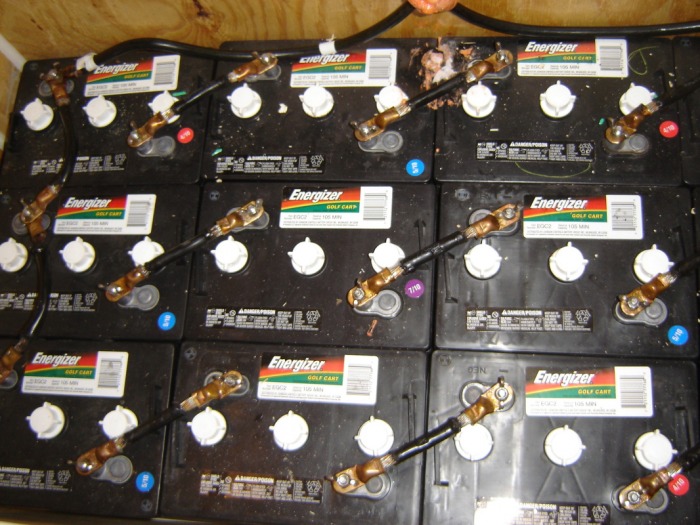
System Components
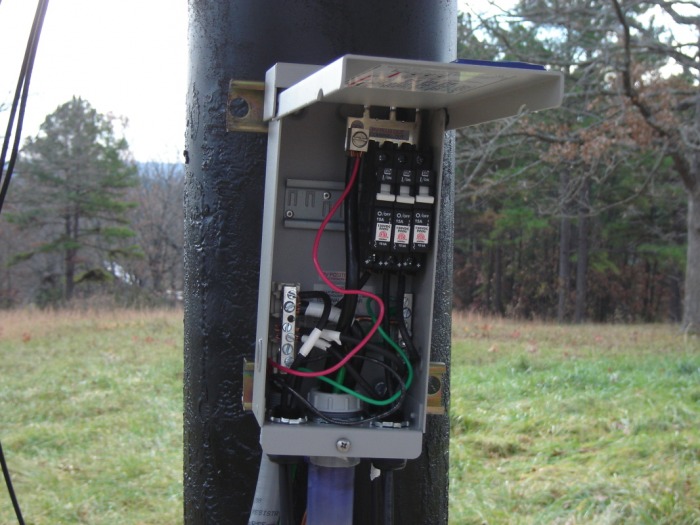
While each home system requires an individual design according to your system load needs and what “fits” best with you, there are some basic components inherent in each PV system.
While each home system requires an individual design according to your system load needs and what “fits” best with you, there are some basic components inherent in each PV system.
~ Photovoltaic solar panels convert sunlight into usable energy through the photovoltaic effect, derived from the use of semi-conductive material, such as silicon wafers, wired together in series. The modules are wired together and combined to make a solar panel. PV panels have greatly improved in efficiency and price over the last decade.
~ The inverter is the brain of the system – its primary function is to convert the DC (direct current) from the photovoltaic panels into pure sine wave AC (alternating current), which is compatible with the electric grid and which we generally use in our homes. Electricity produced by a pure sine wave inverter will be of a higher quality, with less distortion, than electricity produced from the electric grid.
~ The charge controller allows us to get the most from our PV array. It takes the DC power from the panels and converts it into a form that can be used easily by the batteries, the effect being to direct energy in a controlled manner, ensuring that the battery bank is properly charged and operating within recommended parameters. During nighttime, the charge controller prevents electrical back-flow (from the batteries and out of the panels).
~ Batteries are needed in the grid-interactive and off-grid systems, so that you may "bank" your energy production. There are many options from which to choose, insofar as storage size, longevity and price.
~ The inverter is the brain of the system – its primary function is to convert the DC (direct current) from the photovoltaic panels into pure sine wave AC (alternating current), which is compatible with the electric grid and which we generally use in our homes. Electricity produced by a pure sine wave inverter will be of a higher quality, with less distortion, than electricity produced from the electric grid.
~ The charge controller allows us to get the most from our PV array. It takes the DC power from the panels and converts it into a form that can be used easily by the batteries, the effect being to direct energy in a controlled manner, ensuring that the battery bank is properly charged and operating within recommended parameters. During nighttime, the charge controller prevents electrical back-flow (from the batteries and out of the panels).
~ Batteries are needed in the grid-interactive and off-grid systems, so that you may "bank" your energy production. There are many options from which to choose, insofar as storage size, longevity and price.
Mounting Systems
The main choices we have are ground or pole mount and house or roof mount. If your site has the open space, a ground mount allows you to adjust the tilt angle seasonally, either manually or with a tracker. Due to the difference in Earth tilt between summer and winter, it is recommend you make a 30 degree adjustment on your panels in spring and fall. If you want to be more "hands-on", you can adjust your panels incrementally throughout the year. Any of these adjustments allow you to get the most from your panels. The mechanical tracker's main advantage is in the summertime, and it can boost gains by over 30%. You mainly want to have the panels perpendicular to "solar noon" (unless on a tracker), for your best solar gain. A ground mount also gives you more flexibility to brush snow off of your panels and allows sufficient air flow around the panels to keep them cooler, and therefore, more efficient in the summer. While a roof mount is less flexible, it can blend seamlessly with your roof structure and in some cases, may be your best option.
Solar Thermal Hot Water
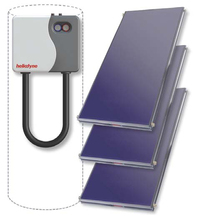
Flat Plate Solar Collectors
Solar thermal panels can be used for hot water and/or home heating systems. These panels are very efficient at transferring sunlight into heat and can save you a lot of money. You can accomplish water heating (a significant portion of your electrical needs) with a only couple of solar thermal panels, compared to needing many solar PV panels to power the electric hot water heater. Therefore, it is much more efficient and money-saving to use solar thermal (heat) panels to heat your water, than to use solar electric panels (PV's) to run power intensive water heaters.
In a solar thermal system, you could use an electric hot water tank as a storage tank in combination with a heat exchanger, which tank can be used on its own or in combination with another tank. Or, you can purchase a unit with an internal heat exchanger that would then flow into your existing hot water.
In Missouri, we would generally use a closed-loop system, in which a pump and a controller circulate food-grade glycol from the collectors to a solar storage tank that stores the heat as hot water. For a hot water heating system, the hot water is then adjusted by a tempering valve and flows into the existing electric hot water storage tank, pre-heated and ready for use. Your current hot water heating system will act as a back-up, generally only heating in very cloudy conditions.
In a solar thermal system, you could use an electric hot water tank as a storage tank in combination with a heat exchanger, which tank can be used on its own or in combination with another tank. Or, you can purchase a unit with an internal heat exchanger that would then flow into your existing hot water.
In Missouri, we would generally use a closed-loop system, in which a pump and a controller circulate food-grade glycol from the collectors to a solar storage tank that stores the heat as hot water. For a hot water heating system, the hot water is then adjusted by a tempering valve and flows into the existing electric hot water storage tank, pre-heated and ready for use. Your current hot water heating system will act as a back-up, generally only heating in very cloudy conditions.
Evacuated Tubes and Flat Panel Collectors
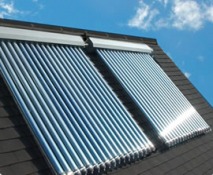
Evacuated Solar Tubes
There are two main types of solar thermal systems - flat plate collectors and evacuated tubes. Evacuated tube collectors are a fairly new technology, which has been extensively used in Northern Europe and China. They are capable of producing significant amounts of heat, even in very cold weather. Evacuated tube collectors tend to be more expensive and have a shorter life-span than flat plate collectors.
Flat plate collectors have been used for decades, are very reliable and long-lived, and are the top choice for domestic hot water.
The heat output of both types of panel is measured in BTUs, allowing for an accurate comparison with your current carbon-based fuel.
Flat plate collectors have been used for decades, are very reliable and long-lived, and are the top choice for domestic hot water.
The heat output of both types of panel is measured in BTUs, allowing for an accurate comparison with your current carbon-based fuel.
Some Advice About a Solar Thermal System Purchase...
Be warned - the most commonly replaced component of a solar thermal system is the AC pump controller. This device gauges the difference between the temperature of the solar water holding tank and the solar panel. When there is heat to be gained, the pump controller will run the pump. HOWEVER, it can malfunction, which is mainly due to the presence of lightning. If your controller breaks, it will leave you with a panel that is too hot and a tank that is cold, leaving the system in stagnation and overheating the solar fluid (glycol solution), shortening the life of the fluid. The solar industry appears to be moving toward combining the pump and controller into a single unit, which makes maintenance difficult and potentially costly.
The good news is, you have another option! A small 20 watt solar PV panel and a DC magnetically propelled pump can do generally the same job for the same price or less, as an AC pump controller. This allows you to bypass using the controller and the long-term system costs and headache related to multiple controller replacement purchases.
A good rule of thumb: the fewer moving parts and less complicated the system, the better off you are.
The good news is, you have another option! A small 20 watt solar PV panel and a DC magnetically propelled pump can do generally the same job for the same price or less, as an AC pump controller. This allows you to bypass using the controller and the long-term system costs and headache related to multiple controller replacement purchases.
A good rule of thumb: the fewer moving parts and less complicated the system, the better off you are.
Tax Incentives
You will receive substantial benefits by heating your water and creating electricity with the Sun's energy. Besides the cost/benefit "payback" you will receive, you can protect yourself from the fluctuations in utilities' cost, and you can feel good about the knowledge that you are using a renewable resource - the Sun!
The Federal Tax Incentive credits at this time are 30% of installed cost for photovoltaic systems and approved solar water/heating systems. These credits are timely with the enactment of the net metering law here in Missouri.
To get a copy of the tax form, go to www.irs.gov/pub/irs-pdf/f5695.pdf.
In addition to the Federal Tax Incentive, Ameren UE and KC Power & Light customers will receive a rebate of $2 per DC watt! For more info on incentives for renewables and efficiency, click here.
The Federal Tax Incentive credits at this time are 30% of installed cost for photovoltaic systems and approved solar water/heating systems. These credits are timely with the enactment of the net metering law here in Missouri.
To get a copy of the tax form, go to www.irs.gov/pub/irs-pdf/f5695.pdf.
In addition to the Federal Tax Incentive, Ameren UE and KC Power & Light customers will receive a rebate of $2 per DC watt! For more info on incentives for renewables and efficiency, click here.
Missouri University of Science and Technology
Renewable Energy Project
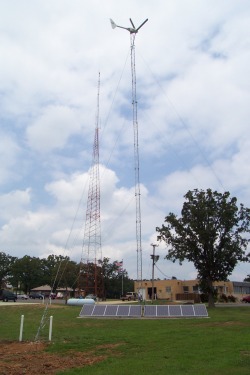
MS&T has instituted a pilot project to monitor the wind and solar gain in Rolla, Missouri.
The project description states, "The renewable energy demonstration project located at the Troop I Highway Patrol Headquarters consists of a grid inter-tie wind turbine system, as well as a grid inter-tie photovoltaic (PV) array system. The wind turbine includes a 10 KW turbine on a 120 ft guyed lattice tower. The PV system includes ten (10) solar panels that, when connected together, can produce 2 KW of energy. The primary objective of the project is to demonstrate that the application of renewable energy systems has the potential to reduce the State’s energy bills."
View the latest data coming from the renewable energy system.
**When reviewing the data, notice how the solar installation is the "workhorse".
The project description states, "The renewable energy demonstration project located at the Troop I Highway Patrol Headquarters consists of a grid inter-tie wind turbine system, as well as a grid inter-tie photovoltaic (PV) array system. The wind turbine includes a 10 KW turbine on a 120 ft guyed lattice tower. The PV system includes ten (10) solar panels that, when connected together, can produce 2 KW of energy. The primary objective of the project is to demonstrate that the application of renewable energy systems has the potential to reduce the State’s energy bills."
View the latest data coming from the renewable energy system.
**When reviewing the data, notice how the solar installation is the "workhorse".
The U. S. Solar Industry
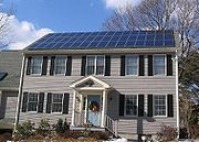
PV system roof mount
The United States is beginning to gain some ground, with investment in pilot projects by the Department of Energy and others. However, the Pew Charitable Trust released a study in 2009 stating that Missouri ranks 49th in the country in renewable energy production. The time for this idea has come, and there is a growing demand for solar energy in this country. The Federal Tax Credits and new stimulus spending will help the industry gain more traction. Proposition C was also a good thing, leveling the playing field somewhat for homeowners to use solar.
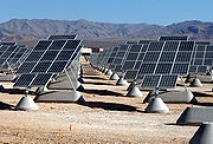
Nellis Solar Power, Nellis Air Force Base
The U. S. Solar Industry grew about 17% in 2009, and the greatest growth was in grid intertie systems, which grew 58% to 792 megawatts. Manufacturing is up and manufacturers are making gains in conversion efficiency, as well.
PV's of the World
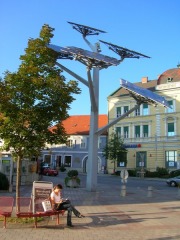
PV system 'tree' in Austria
Japan and Germany have been actively working to equip residential homes with PV solar panels, and the dedication of these countries is shown in the public arena, as well.
Due to subsidies early on, Germany and Japan now have a booming solar PV industry. Part of Germany's success has been due to the feed-in tariffs, where generated solar power was priced higher than conventional, so that people were reimbursed at a higher rate. This feed-in tariff is still going on (in 2011), and Germany is now set to retire its nuclear plants.
Due to subsidies early on, Germany and Japan now have a booming solar PV industry. Part of Germany's success has been due to the feed-in tariffs, where generated solar power was priced higher than conventional, so that people were reimbursed at a higher rate. This feed-in tariff is still going on (in 2011), and Germany is now set to retire its nuclear plants.